Six Slab Exercises for Stronger Legs
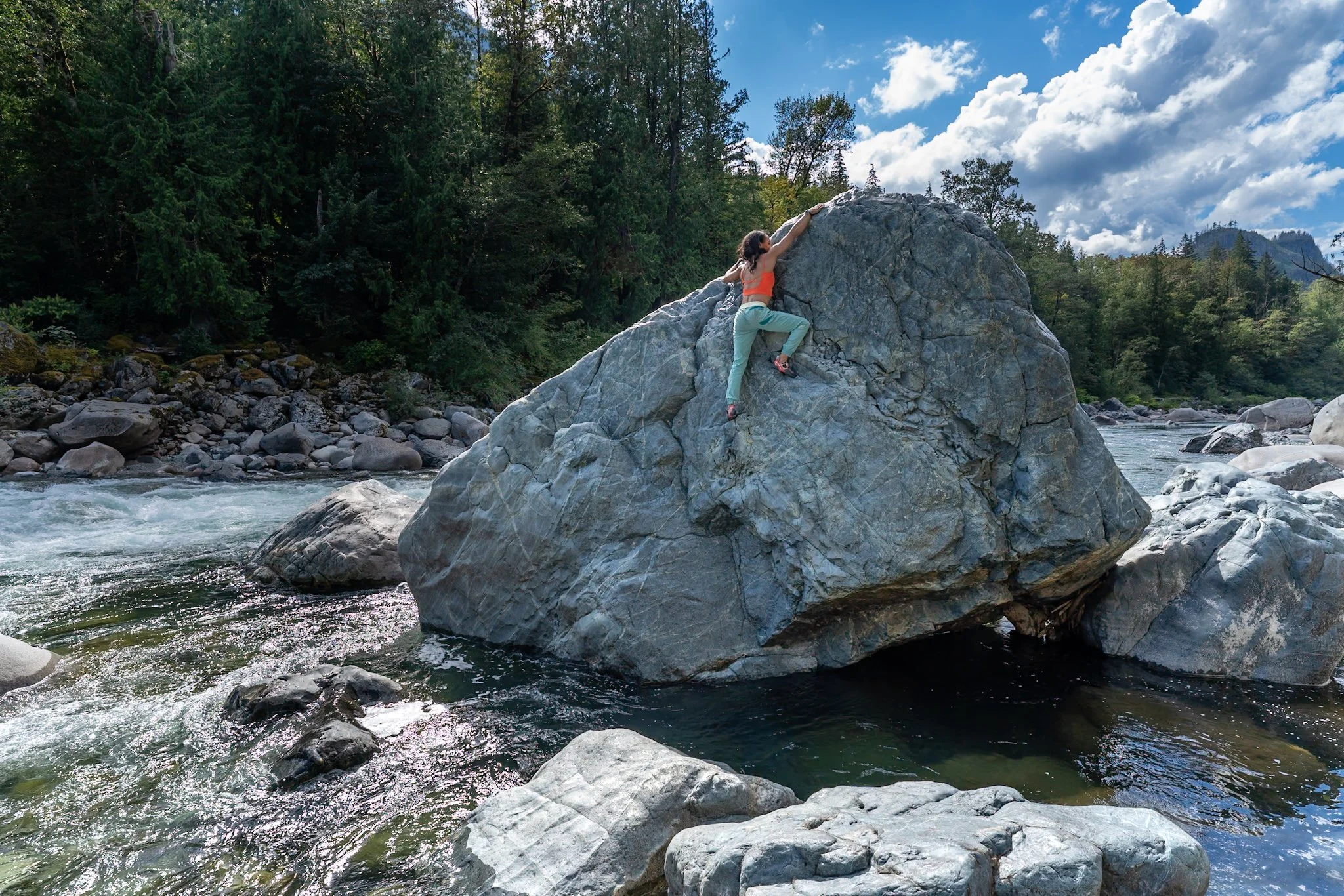
A few months ago, when my coach said I needed to climb slab in order to climb a V14 roof, I thought he was nuts. Now that I’m three months into climbing slab, I can say with 100% certainty, he was right. I have seen huge gains in my ability to climb at all angles. I recently visited my mega V14 project and I was able to do moves that I couldn’t do previously. Luckily for me, I love slab. But even if you don’t love slab, I HIGHLY recommend that climbers add 10 minutes of slab to their regular climbing routine. You won’t regret it.
Here are the beginner exercises that have improved my climbing so far . These exercises are all done without using hand holds so that my legs have to do all the heavy lifitng.
No Hand Step Ups
The goal is to be able to step up as high as possible. This is currently max step up height, which feels higher than it looks in this video. Start out as small as you want to make sure you can successfully step up. Pay attention to the body position that allows you to step up. For me, it is important to pay attention to the position of my sacrum and rotate it into the position that gives my legs the most strength.
2. No Hand High Step Up and Step Down
My first two months on the slab, I thought high steps were incredibly difficult. Then my coach mentioned stepping down and that was much more difficult! This skill is useful if you ever climb a highball slab and need to downclimb.
3. No Hand Walk Through
This exercises almost makes you feel like you’re competing on the IFSC world stage. Pick a path of foothoolds that you can transverse. Try stepping through. Matching feet. Pick your own adventure!
4. No Hand Single Foot Isometrics
I realized I couldn’t move off of some footholds because I couldn’t even stand on them. So to strengthen my foot, in particular the big toe, I do isometric holds on one foot on progressiely smaller holds. I also do this on larger slopey jibs.
5 & 6. No hand Heel Hook/ isometric HOLDS
The slab is great for practicing heel hooks. I do two exercises. First I pick a hold I want to touch and without using handholds, I reach over to touch it. Then using my heel hooking leg, I pull myself back up. To adjust the difficulty, I change the non-heel hooking foot. A less positive foot jib means the heel hook has to take more weight.
I also do heel hook isometrics, where I hold a position instead of reaching for a hold. I hold at different positions each time to work different parts of my hamstring.
I hope these exercises are helpful improving your climbing, no matter what angle you climb. I’ve also heard through the grapevine that the secret to Noah Wheeler’s V17 success is slab training! :)