5 Things I Learned Training for My First 50k
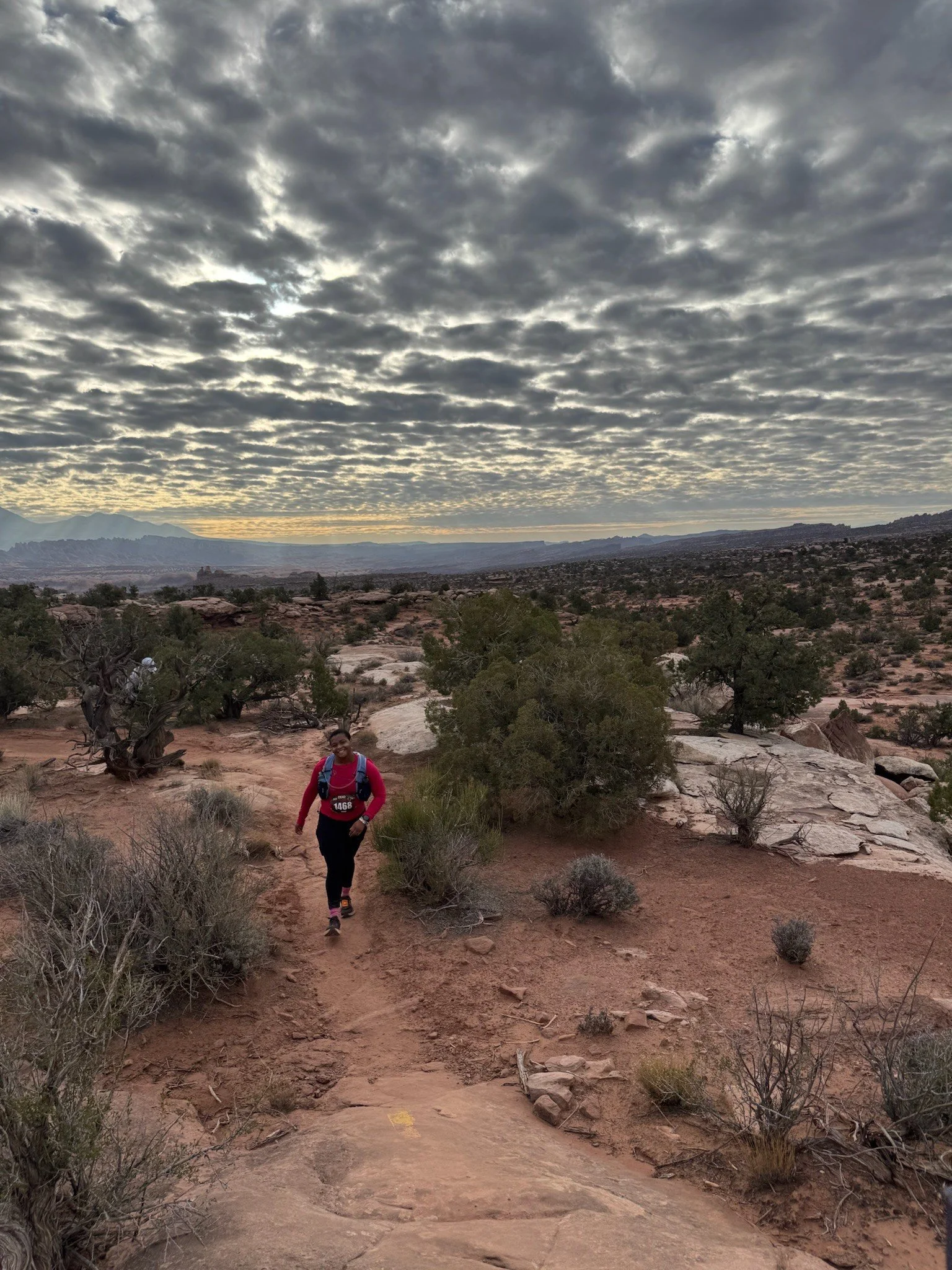
Two miles into my 50K in Moab, Utah. Photo credit: Sam Kaweski (@samanthakaweski).
After climbing Mt. Kilimanjaro this year, I started wondering, What’s next? Moving my body makes me happy, but sometimes training feels boring without a goal to work toward. I wanted something that felt just outside my comfort zone. Something big enough to challenge me, but not so overwhelming that I’d quit before I even began.
That’s when I found ultrarunning. An ultramarathon is any run longer than 26.2 miles. Fifty miles felt too big for this season of life, but a 50k (30 miles) felt perfect. Training turned into five months of early mornings, late lifts and many, many pep talks to myself.
Here are the five biggest lessons I learned while training for my first 50k.
1. Find Your People
Have you ever canceled on the group chat last minute? Remember the guilt you felt for being a “bad friend”. Ultrarunning taught me to be loud and proud about my training goals — and to ask for support.
You need people who don’t get upset when you cancel brunch for a 15‑mile run. People who might not fully understand ultramarathons but still support you anyway. Training for an ultramarathon takes more than strong legs. It also takes emotional support. You need people you can text after a bad run. People who check in on you before a long day of training. People who say, “You’ve got this,” when your brain says the opposite. If you’re lucky, you’ll even find friends who lace up and run a few miles with you.
I had recently moved to a new state, when I somehow stumbled into a group of women who were also training for ultras. We talked about fueling, routes, and the days when every mile felt impossible. Their support didn’t remove the hard days, but it made the hard days feel less lonely. Sometimes one person is enough. Sometimes a small community forms around you without you even trying. Either way, their support makes showing up for yourself feel possible.
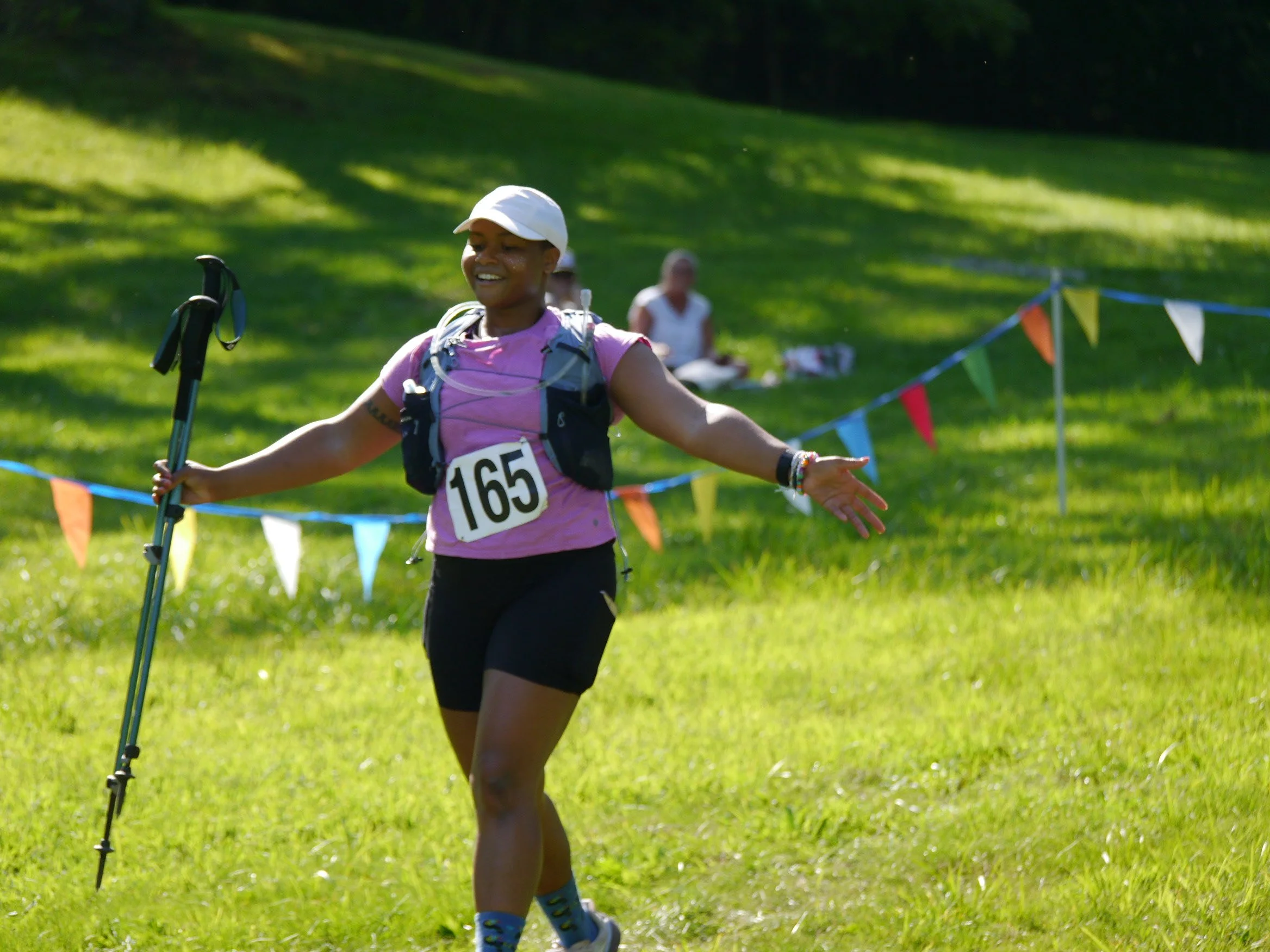
Finish line of my first 25K trail race in August 2025 in Richmond, Vermont.
2. Embrace Your Type B
Long‑distance running requires a plan, but it also requires flexibility. Life doesn’t stop when you start training. You still get sick. You still travel. You still have work stress, family emergencies, and unexpected moments that pull you in different directions.
Here’s the truth: your body doesn’t know what your planned run was. It only knows if you exercised or not. Once I understood this, it helped me release the “all or nothing” thinking. For me, training overlapped with starting a new job, learning a new industry, and settling into a new state. There were so many weeks I had to decide what “enough” looked like. Sometimes enough was doing half a lift instead of the full workout. Sometimes it was running 40 minutes instead of 90 minutes.
Being flexible doesn’t mean slacking. It means listening to your body. It means recognizing that progress sometimes means three steps forward and one step back. Some weeks you hit every workout. Some weeks you don’t. That doesn’t make you a failure. It makes you human. And honestly? Being flexible builds confidence and resilience. It helps you trust that you can still reach a goal even when life is messy.

I visited Arches National Park the day before the race to ground myself. Photo by: Brittany Wiley.
3. You Will Have Bad Days
Some days, everything feels heavy. Some days you question why you ever signed up for something this long. Some days your legs feel like cement, and even a short run feels impossible. But bad days are part of the process. A training plan is not a rulebook you have to follow perfectly. It’s a guide and a way to help you grow without expecting you to be a machine. The bad days teach you what grit feels like. They show you that you can keep moving even when your mind wants to stop. They prove that progress isn’t supposed to be straight and predictable. And sometimes, a bad run teaches you more about yourself than a perfect one.
4. The Power of Discomfort
Discomfort changes you. Running long distances means facing moments when you doubt yourself. I’ve been running for more than ten years, and I still have days where I look at my shoes and think, I don’t know if I can do this today.
That’s when I return to a simple phrase: All I’m asking myself to do is show up. Some days the miles fly by. Other days every step feels like work. But every moment of discomfort teaches you something. It teaches you about patience, resilience, and about how strong you really are.
I’ve learned that chasing a big physical challenge builds self‑trust. It’s easy to stay accountable when someone else is counting on you. But can you stay accountable to yourself? Can you do the hard thing even when no one is watching? Training helped me answer yes. And the more comfortable I got with discomfort, the more brave I felt in other parts of my life.
Comfort zones aren’t just personal. They’re deeply cultural, shaped by the environments we grow up in and the narratives we repeatedly see and absorb. From a young age, most of us learn what is “for people like us” and what isn’t, often long before we consciously choose our interests.
Cultural norms, representation, and access all quietly draw the boundaries of what feels possible. When you rarely see bodies like yours, backgrounds like yours, or identities like yours reflected in certain spaces, especially in endurance sports, those spaces can feel off-limits, even if no one explicitly says so.
I noticed that trail running, ultramarathons, and outdoor recreation have a very specific look in media and advertising. It reinforces the idea that only certain people belong. We are subtly taught to shrink our aspirations to fit. But stepping outside that comfort zone isn’t just a physical act; it’s a cultural reclamation.
Training for a 50k became more than long miles and early mornings. It was my way of rewriting the script I was handed. Every run became a quiet refusal to let cultural norms dictate my capacity. Every new distance became evidence that access can be expanded. Every moment on the trail became an assertion that representation grows when I show up as myself. In that way, this 50k isn’t just a race; it’s a statement. I chose to take up space in a landscape that did not envision me. Stepping beyond my comfort zone becomes an unlearning of limitations, a claiming of identity, and a reminder that culture doesn’t just shape us. I get to shape it back.
5. Showing Up for Yourself Always Matters
Even if you don’t follow your plan exactly, showing up, even for a mile or two, still counts.Some days I don’t fully understand why I’m running a 50k. It doesn’t mean anything to anyone but me. But that’s also what makes it special. It’s mine. Ultrarunning teaches you to listen to your body in new ways. You learn when to push, when to rest, and when your brain is avoiding discomfort versus when you truly need recovery. I’ve also noticed a new curiosity growing inside me. I catch myself wondering, What else can I do? How far can I go? Will I break? But the more miles I run, the more I learn this truth: the win is not the perfect race — it’s the act of showing up again and again.
On November 15th, I completed my first 50k in Moab, Utah, alongside two friends I met climbing Kilimanjaro. All I asked of myself was to show up to the start line and go as far as I could.I laughed. I practiced gratitude for my body, my ability, and the people who believed in me. I cried at the finish line.And now my ask for you is simple: go find something that shows you what you’re made of.
You might surprise yourself with what you find.





The outdoors can be a dangerous place and fear might initially keep you from trying new things. So here are four reasons why you should do it scared.