Finding My Line: A Woman’s Wade Into Fly Fishing
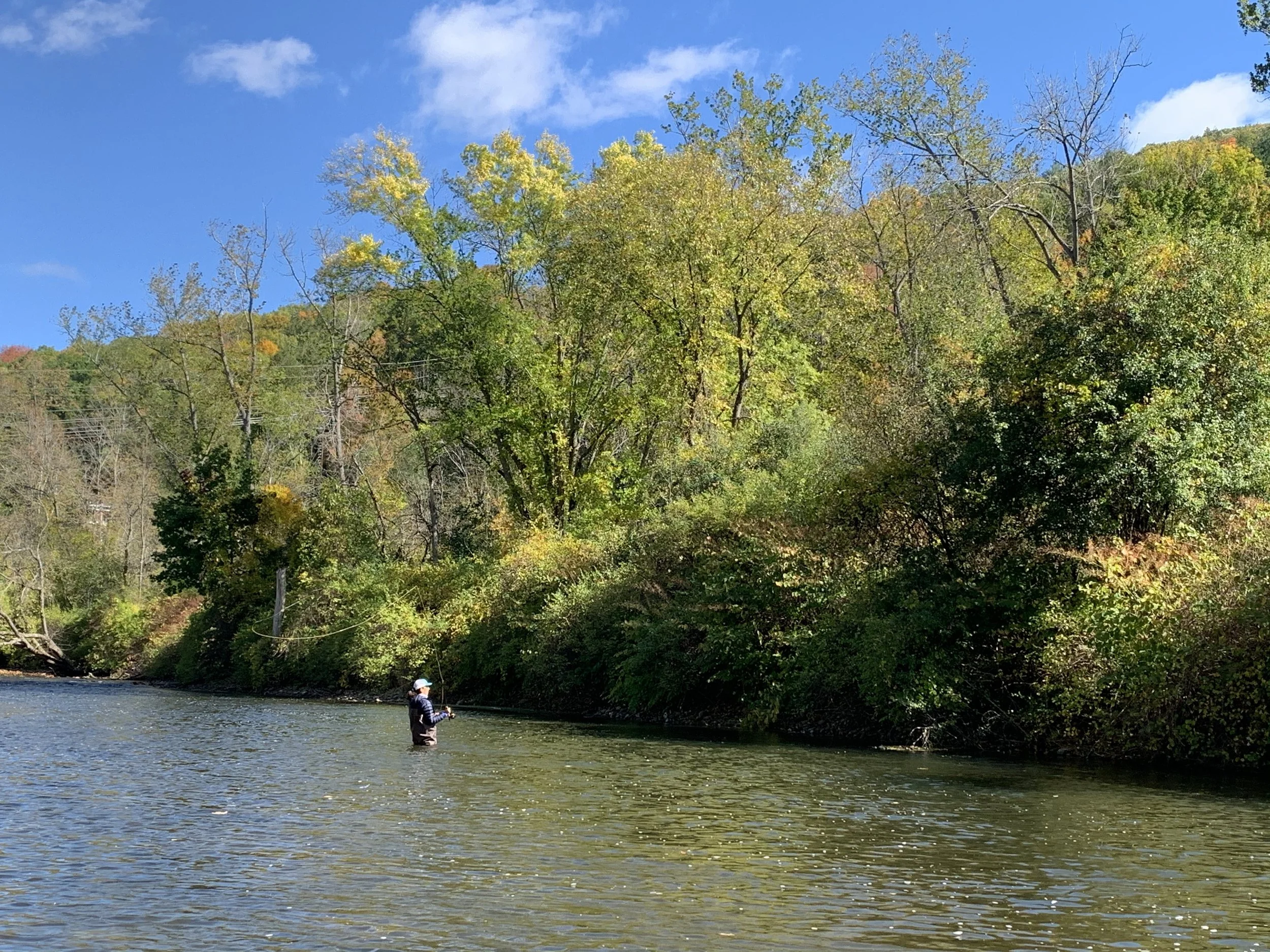
Casting my line at the Berkshires, MA (Photo credit: Joe Krahe)
At thirty years old, I had never held a fishing rod. Never tied a fly, never cast a line, never felt the tug of a fish fighting on the other end. But I'd always been drawn to the idea of fly fishing. Maybe because I loved the book "A River Runs Through It" and its movie adaptation. Maybe because I've always loved being on and around water. Or maybe it was just that fly fishing seemed romantic and meditative.
During the pandemic in July 2020, my husband and I decided to take fly fishing lessons near Seneca Rocks, West Virginia. Our guide met us at a stunning spot along the river. Across the water rose a massive rock face, the kind that makes you feel small in the best way. The water ran clear green and cold, and the sun beat down on what turned out to be a gorgeous Fourth of July weekend.
Our guide didn't actually have us fish that day. We didn't wade into the water or try to catch anything. Instead, he taught us the fundamentals on dry land: how to tie knots, how to set up the rod and line, how to cast with various techniques. Even without getting my feet wet, I was drawn to the details and rhythm of it all. I knew immediately that I wanted to learn more.
Wading Further
Seneca Rocks, WV (Photo credit: Joe Krahe)
Three months later, in October 2020, my husband and I found ourselves around Lee, Massachusetts, in the Berkshires. We went out with Harry Desmond, the owner of Berkshire Rivers Fly Fishing, on a stunning fall day.
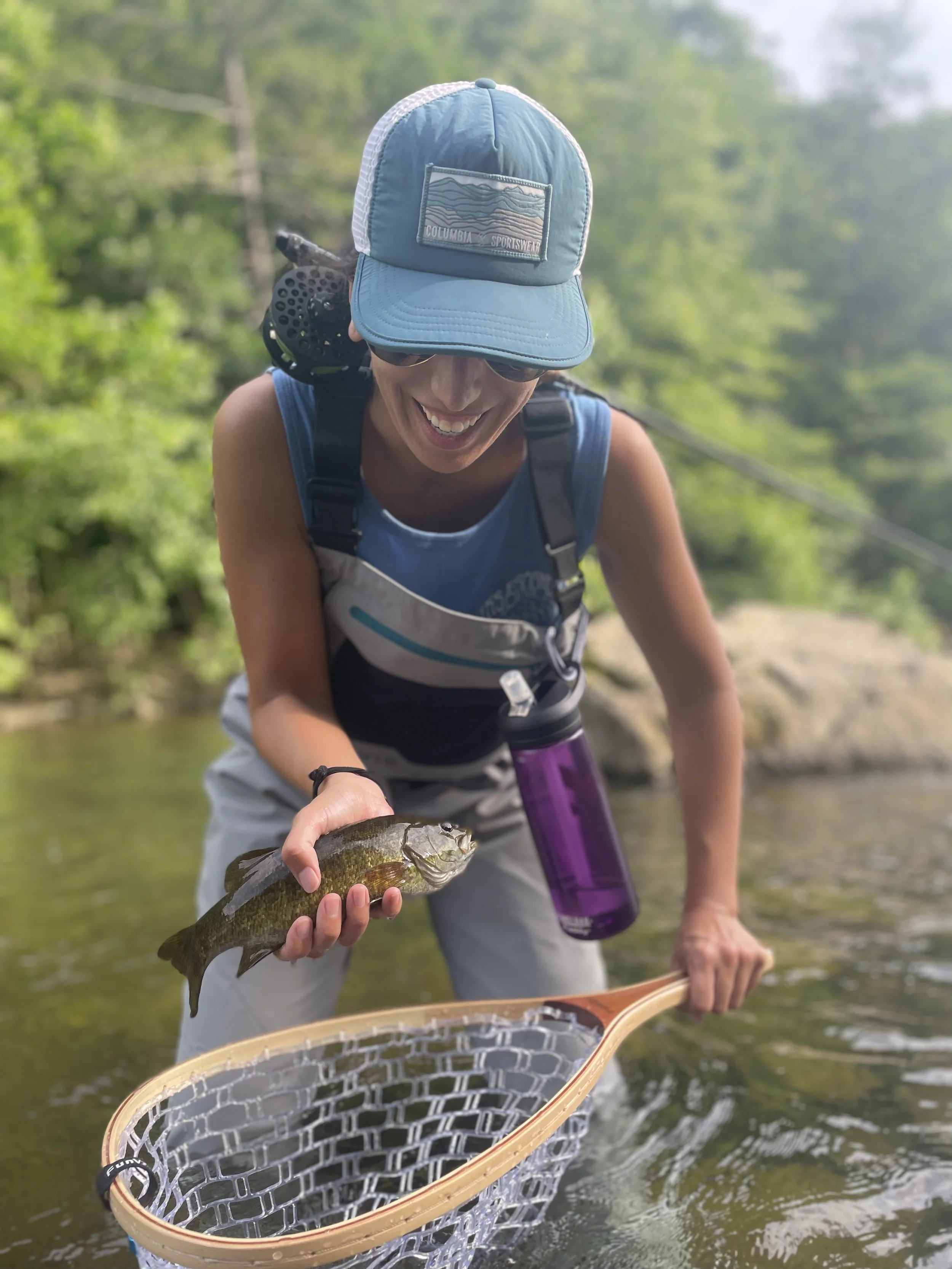
This time, we actually fished. And I caught fish. The feeling was incredible! I did not expect to be so taken by the moment when I felt the weight on the line. I immediately started apologizing to the fish and worked swiftly to get the fish off the hook, holding him firmly but gently to avoid harming his slime coat or gills or jaw and then releasing him upstream.
“I find fly fishing meditative. I’m moving deliberately, constantly scanning the water, always adjusting. ”
That day on the river got me so hooked that my husband and I decided that we would spend an entire springtime month in Asheville, North Carolina, so we could fly fish every single day after work.
That month in Asheville was a dream. We explored different streams and rivers, learned new spots, practiced techniques, and actually got better slowly but surely — although we still got our lines tangled in tree branches regularly. And when I did actually catch a fish on our barbless flies, I was instantly apologizing to the fish and moving swiftly to get them back in the water as gently and efficiently as possible.
I find fly fishing meditative. I’m moving deliberately, constantly scanning the water, always adjusting. I enjoyed coming to understand more about where the fish might be hanging out, how the river currents and seams move, what insects are looking yummy to the fish, and how the light hitting the water might affect my outing.
I enjoyed such tranquility in that daily routine of working, then fishing. The repetitive motion of casting itself felt like the way I count my strokes while swimming laps. Yet another water-powered way to find a quiet mind and a smile on my face.
Since that month in Asheville, I've continued to fly fish whenever I can, even if only a few times a year, whenever I'm near a river or stream — whether that's in Connecticut, Colorado, or anywhere else.
I don’t always catch fish, but I always enjoy an hour or a day or a weekend on the river. Each time, I feel that same pull, that same sense of coming home to something. Plus, my husband will be the first to say — in a proud and supportive way — that I catch more fish more consistently out of the two of us.
An Unforeseen Undercurrent
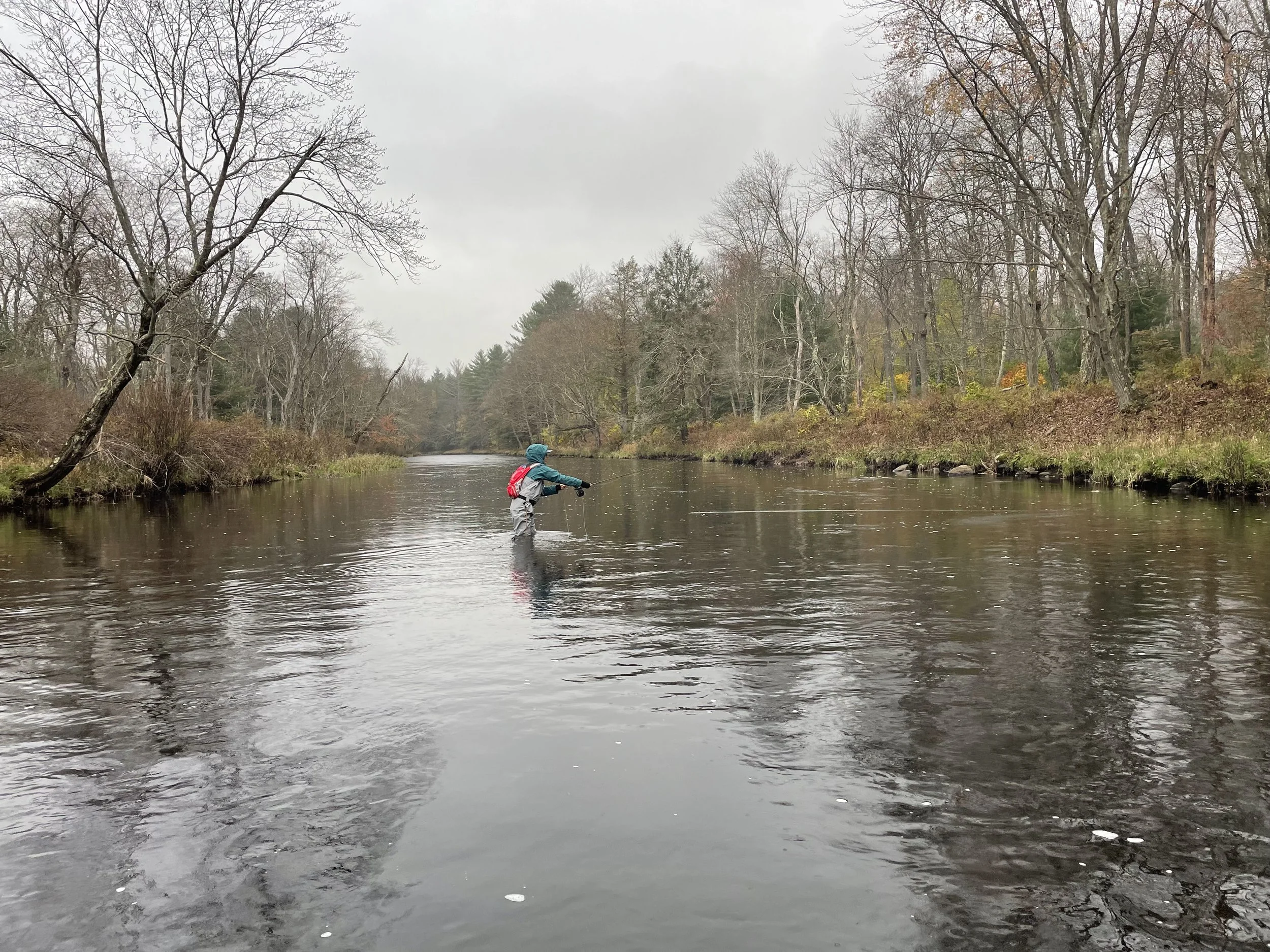
Fishing in the Poconos, PA (Photo credit: Joe Krahe)
But there's another part of this story, one that I felt foolish for not fully anticipating. I'm often the only person on the river and in the fly shops who looks like me. And that plays out in palpable ways on the water.
In fly shops a few times, staff barely return my greeting and instead attend to my husband, even though I’m the one who picks out our gear and our flies to “match the hatch.” The assumption seems to be that he is the angler, and I’m just his supportive spouse, tagging along.
I remember one afternoon on a fork in West Virginia. I was working a particularly good stretch of water, and I'd already landed two pretty trout. My rod was bent with another fish on the line — I was actively fighting it, you could see the arc of my rod and the tension in my line. A couple anglers appeared on the bank, seemed to not see me, and started asking my husband about what flies were working and whether he had any tips for the spot.
My husband pointed at me and said, "She's the one catching them." I continued reeling in as I shared what seemed to be working that day. The man barely glanced at me and then continued the conversation with my husband as though my husband had said what I’d just said.
Being ignored or dismissed completely is never fun, and I certainly tire of the condescension. I find mysterious the refusal to engage with me on a shared interest outdoors — when passersby don’t wave back on a hike, when a surfer gruffly shouts unsolicited advice, or when a fellow angler simply doesn’t acknowledge that I just answered their question.
I tend to assume that I am not at odds with the humans around me — that we all need and want a lot of the same things to lead a fulfilling life. So I continue to feel surprised when someone, who clearly loves being on the water like I do, doesn’t want to connect about that shared experience. I suspect these interactions would be more enjoyable for everyone if we could connect, even for a quick hello. Then I feel silly for ever being surprised.
Different regions, different rivers, same dynamic. These moments tend to get old since they’re so overplayed, not just for me but for women in a multitude of outdoor activities.
A Gift From the Guides
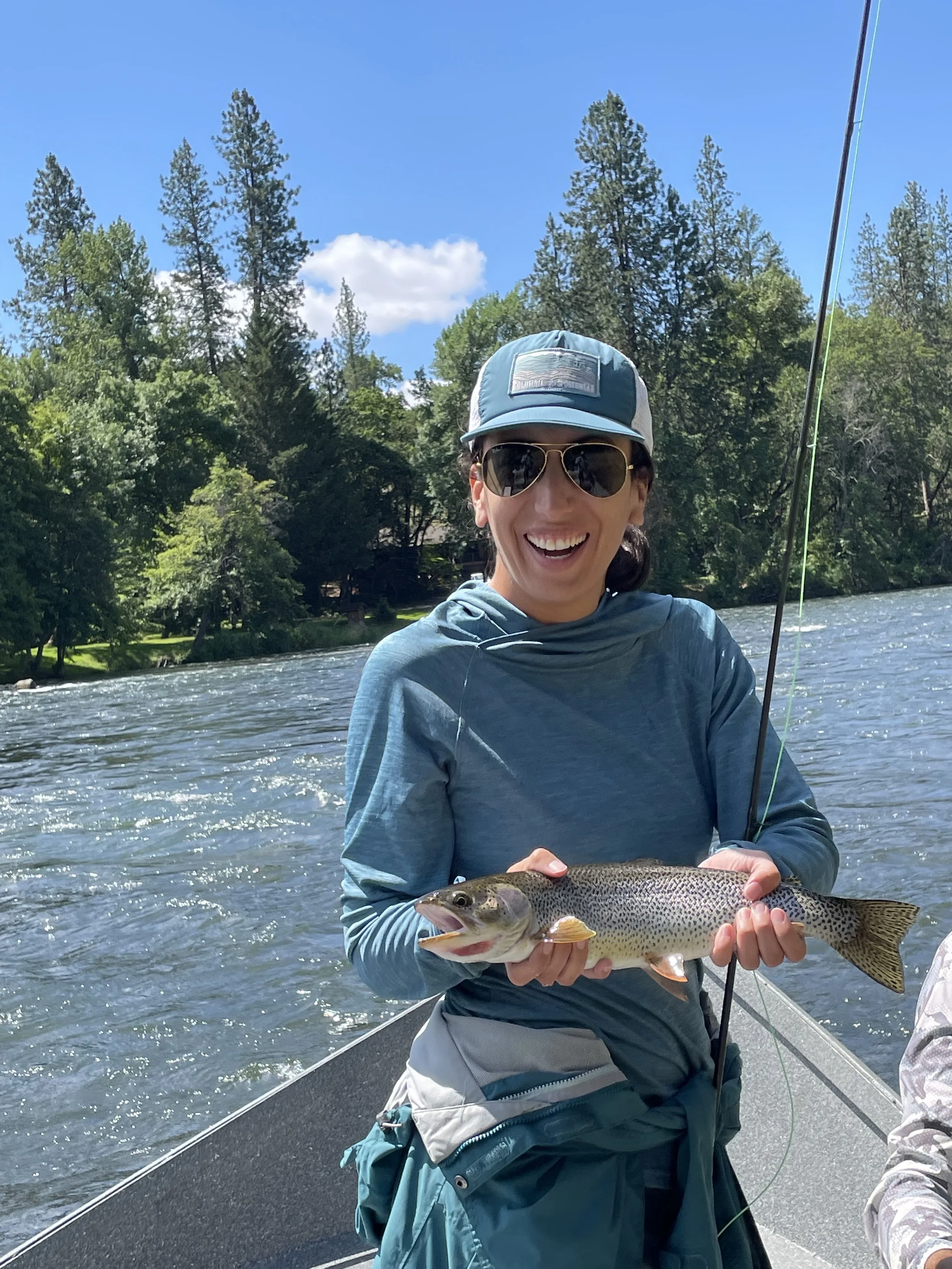
Ashland, OR (Photo credit: Joe Krahe)
I’ve often seen fly fishing portrayed as an elite sport with expensive gear and an homogenous aesthetic. I went into it knowing the cultural image of a rugged outdoorsman, the expert angler who knows every hatch and can read the water like a book.
Thankfully, Harry at Berkshire Rivers Fly Fishing told me that in his decades-long career as a fly fishing instructor and guide, he often sees women advance more swiftly than men. Harry spoke to women’s patience and ability to implement feedback and level-headed problem-solving when they're not catching anything.
I’ve worked with several other expert guides, like Harry, who played a positive influence in fortifying my sense of belonging on the river.
“When I’m standing in a river, part of my brain is still sometimes wondering whether I’m being watched, or whether someone is going to take issue with the space I’m taking up.”
One treated me like he treated my husband. We talked about the Grateful Dead and National Parks and what it’s like to run a fly fishing business. Another kept throwing my 18-inch fish back in the river before I could even take a millisecond to appreciate them (the biggest catches of my short fly-fishing career) because he was so confident I was on the verge of catching a 25-inch steelhead on the Rogue River in Oregon.
These standout guides helped shape my experience into what it should be for all anglers: pure peace and joy. (Except for when you realize you’re surrounded by thin snakes and your blood-curdling screams send all the birds flying out of the surrounding trees.)
When I'm standing in a river, part of my brain is still sometimes wondering whether I'm being watched, or whether someone is going to take issue with the space I’m taking up. But these guides are the wind at my back, reminding me to cast from my left if the wind is at risk of blowing my own hook into my face.
Both Are True
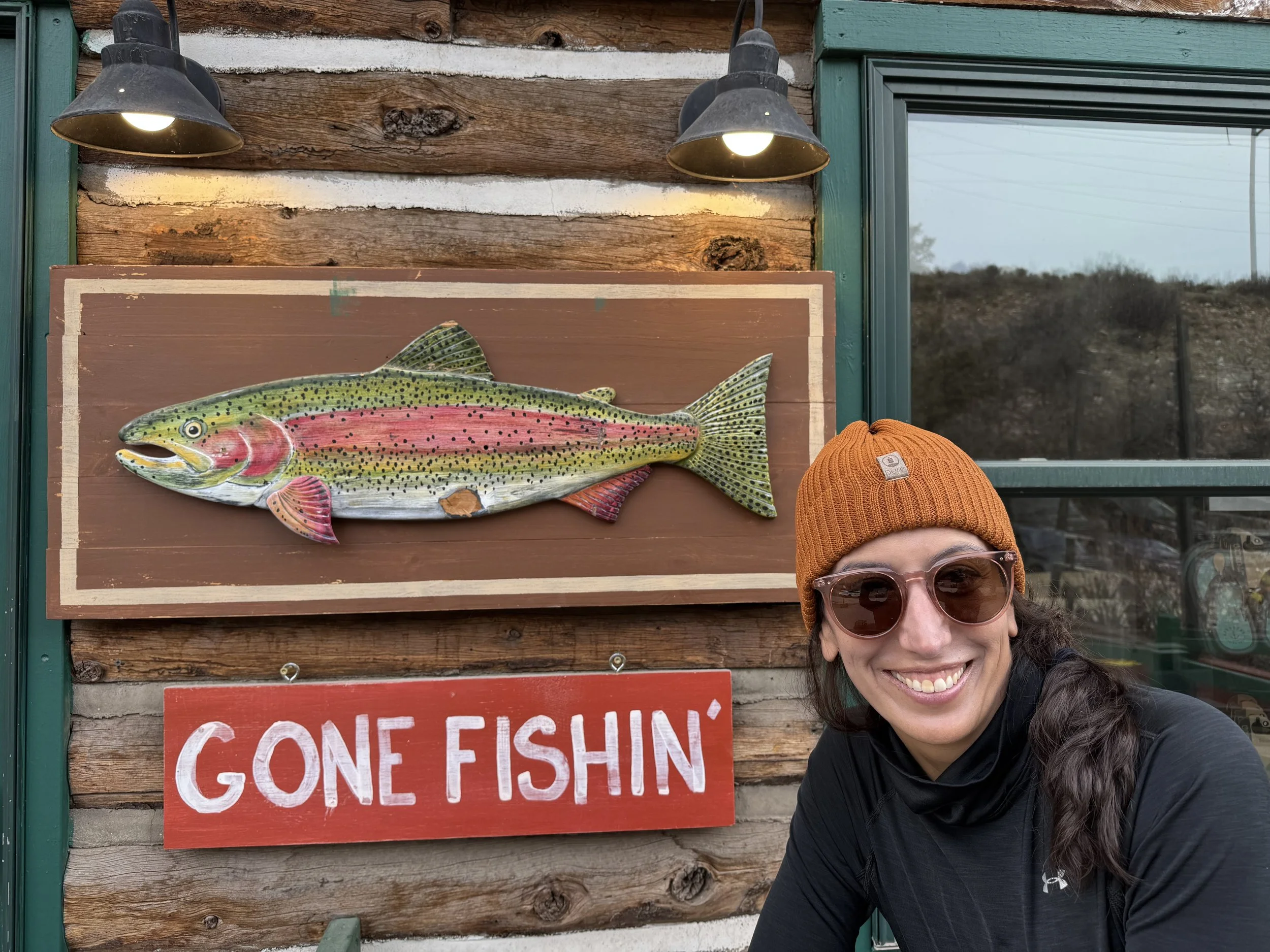
Where it all starts: my local fishing store (Photo credit: Joe Krahe)
I keep going back to fly fishing and making new friends or new bonds with old friends over it.
When I'm in the rhythm of casting everything else falls away. Any microaggressions or resulting discomfort are easier to let float on down the river when I’m focused on connecting with the water, trees, fish, birds, and rocks that eat my flies.
For me, fly fishing is another wonderful way of being fully present, fully myself — just like any other angler, doing something we’re lowkey obsessive about.
I figure both things are true: I can experience both the joy of fishing and the sting of exclusion at the same time. As long as I don’t sense any physical danger, I just feel that discomfort and keep casting anyway.
For anyone interested in trying out fly fishing, take care of your safety. Let your people know where you're going, buy the correct fishing permit, trust your instincts, and travel with others when possible. Start with the book “Fly Fishing for Dummies” like I did, and stop by the local fly shop for local river knowledge.
Bonus: if you have an Orvis store within an hour, go take one of their free fly fishing 101 classes at the store and be sure to ask about water safety: what to watch for, weather changes, what to do if you lose your footing.
Drive to that river. Walk into that fly shop. Ask those questions. Take up that good-looking spot. Cast your line!
Every time you do, you're recasting the cultural image of who gets to be an angler, who gets to be outdoorsy, who gets to find peace as part of nature.
The Cult of One More Cast
At this point, I've fished in rivers across the country, from West Virginia to Massachusetts to North Carolina to Colorado to Oregon and California. I've gotten better at reading water and selecting flies.
I've gotten slightly better at tying knots and at mending my line to get a natural drift. I've felt the thrill of a fish on the line and the satisfaction (and still relief) of a clean, quick release.
And there are still so many waters to wade into. I hope to see you out there — holler and wave if you see me!